Chess Middlegame Guide Kids Can Really Use
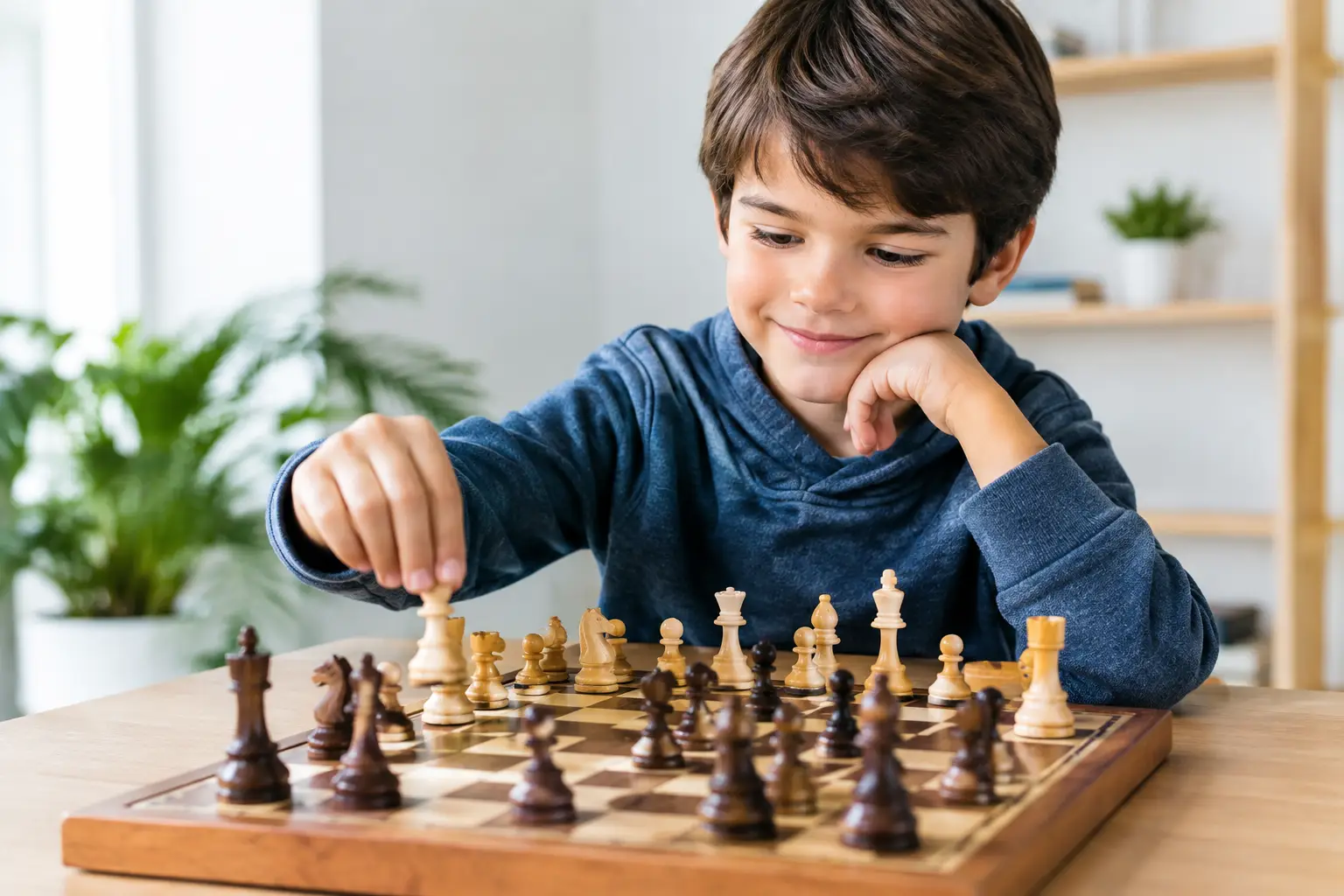
The opening is over. Your child has developed a few pieces, castled, and then suddenly asks, “What do I do now?” That moment is exactly why a chess middlegame guide kids can understand matters. The middlegame is where children stop following opening moves and start making decisions for themselves.
For young players, this can feel like the hardest part of chess. There are more pieces on the board, more possible moves, and plenty of tempting attacks that do not quite work. The good news is that kids do not need to memorize dozens of complicated plans. They need a clear thinking routine, a few reliable ideas, and enough practice to spot what the position is asking for.
What Is the Middlegame in Chess?
The middlegame begins after the opening, usually once both sides have developed pieces and made their kings safer by castling. It ends when many pieces have been traded and the game becomes an endgame.
Unlike the opening, there is rarely one “book move” to copy. A child must look at the whole board and decide what matters most. Is a piece under attack? Is the king exposed? Is there an undefended pawn? Can a piece move to a better square?
That is a big shift, especially for beginners. Early on, many children see chess as a hunt for captures. In the middlegame, they learn that a quiet move can be stronger than grabbing a pawn. Improving a knight, protecting the king, or stopping an opponent’s plan may win more games than a flashy move.
The First Rule: Look for Threats Before Making Plans
Before a child starts an attack, they should ask one simple question: What is my opponent threatening?
This habit prevents many avoidable losses. A player may see a chance to attack the enemy queen but miss that their own queen is hanging. Or they may move a knight forward and overlook a checkmate threat on the back rank.
A useful pre-move checklist has four questions:
- Is my king safe from checks or checkmate threats?
- Is any of my piece or pawn attacked and undefended?
- What changed after my opponent’s last move?
- If I make my move, what can my opponent capture or check?
Parents can reinforce this at home without needing to be chess experts. After your child suggests a move, simply ask, “What is your opponent’s best reply?” This question builds patience and helps children move away from impulsive play.
It is also worth setting realistic expectations. Even strong young players miss threats sometimes. The goal is not to find every tactic immediately. The goal is to build a repeatable habit of looking.
A Chess Middlegame Guide for Kids: Make a Simple Plan
Once the board is safe, it is time to make a plan. For children, a plan should be short and concrete. “I will control the center, improve my knight, and attack the weak pawn” is much more useful than “I will play positionally.”
Here are the most helpful plans for young players to recognize.
Improve Your Worst Piece
Ask your child: “Which of my pieces is doing the least?” A rook stuck in the corner, a bishop blocked by its own pawns, or a knight sitting on the edge often gives a clear answer.
The old chess saying is true: a knight on the rim is often dim. It is not always wrong to place a knight near the edge, but center squares usually give it more options. A knight on e4 can jump to many important squares. A knight on a1 has very few choices.
Improving the worst piece is a wonderful plan because it does not require a complicated attack. It teaches children to notice where their pieces belong and gives them a productive move when no tactic is available.
Attack a Weak Pawn or Square
A weak pawn is one that cannot be easily protected by another pawn. An isolated pawn, a backward pawn, or a pawn that has moved too far forward can become a target.
Kids can begin with an easier version: look for pawns that are defended only once or not defended at all. If an opponent has a pawn on c5 protected by one piece, your child may be able to attack it twice. That creates pressure, even if the pawn is not captured right away.
Weak squares work similarly. If the opponent has moved a pawn and can no longer control a nearby square, a knight may be able to settle there. A strong knight in the center can be more valuable than a bishop that has no open diagonals.
Use Open Files for Rooks
Rooks are powerful, but beginners often leave them sitting behind their pawns for the entire game. In the middlegame, children should look for open files - vertical columns with no pawns - or half-open files, where only the opponent has a pawn.
Placing a rook on an open file can create immediate pressure against a pawn, a king, or another rook. If both rooks can work together on the same file, the pressure grows quickly.
There is a trade-off, though. A rook move should not leave the back rank weak or abandon an important defender. Encourage children to check safety first, then look for active rook squares.
Attack the King Only When Pieces Can Help
Young players love attacking the king, and that enthusiasm is valuable. But one queen cannot usually deliver checkmate against a defended king.
A good kid-friendly rule is this: before launching an attack, count how many pieces are helping. If your child has a queen, bishop, and knight aimed near the enemy king while the opponent has few defenders, an attack may be promising. If only the queen is nearby, it may be wiser to improve a piece first.
Checks are important, but not every check is good. A check that forces the king toward safety or allows the opponent to win your queen is not an attack. Teach children to ask, “After my check, where can the king go, and what happens next?”
Think in Candidates, Not in One Fast Move
Many mistakes happen because a child sees the first move they like and plays it immediately. Stronger chess thinking begins when they compare a few candidate moves.
A simple order works well:
- Look at checks.
- Look at captures.
- Look at threats.
- Look at improving moves.
This does not mean every check or capture must be played. It means those moves deserve attention because they can change the position quickly. After looking at them, your child can decide whether a quieter move is better.
For example, a child may see that they can capture a pawn with their queen. But after checking the opponent’s reply, they notice the queen could be trapped. Instead, they may choose to develop a rook to an open file. That is real progress: not just seeing a move, but comparing consequences.
When Should Kids Trade Pieces?
Trading pieces is one of the most confusing middlegame decisions. Children often trade automatically because a capture is available. Other children refuse every trade because they are afraid of giving up an attacker.
The better answer is: it depends on the position.
If your child is ahead in material, trading pieces often helps because fewer pieces make it harder for the opponent to create complications. If they are behind, keeping more pieces on the board may offer more chances to create tactics or an attack.
A trade can also be useful when it removes an opponent’s strongest piece. If an enemy knight is dominating the center, exchanging it may be a smart decision even when the pieces are equal in value.
Before trading, kids can ask: “Does this help my position, or am I just capturing because I can?” That one pause can change the quality of a game.
Turn Mistakes Into Better Questions
After a game, avoid starting with, “Why did you make that move?” Children learn faster when analysis feels curious rather than critical.
Try questions such as: “What was your plan here?” “What did you think your opponent would do?” and “Which piece needed help?” These questions reveal whether the issue was a missed threat, a rushed move, or a plan that needed more support.
At Savushkin Chess, coaches use this kind of guided review to help young players understand their choices, not just memorize a correction. A child who can explain why a move failed is much more likely to recognize the same pattern in the next game.
Practice One Middlegame Skill at a Time
A child does not need to solve every part of the middlegame at once. One week, focus on checking for hanging pieces before every move. The next week, focus on finding the worst-placed piece. Later, practice rook activity or king attacks.
Short games with a specific mission can work especially well. For instance, challenge your child to place a rook on an open file, or to name their opponent’s threat before every move. The result of the game matters less than practicing the habit.
The middlegame becomes far less mysterious when children learn to slow down, scan for danger, and give their pieces a job. Every thoughtful move builds more than chess skill. It builds the confidence to face a busy board, make a plan, and adjust when the position changes.

Ready to see chess click for your child?
Book a free 20–30 minute trial lesson with one of our coaches — no commitment, no payment needed.