
A Parent's Guide to Chess Notation Basics
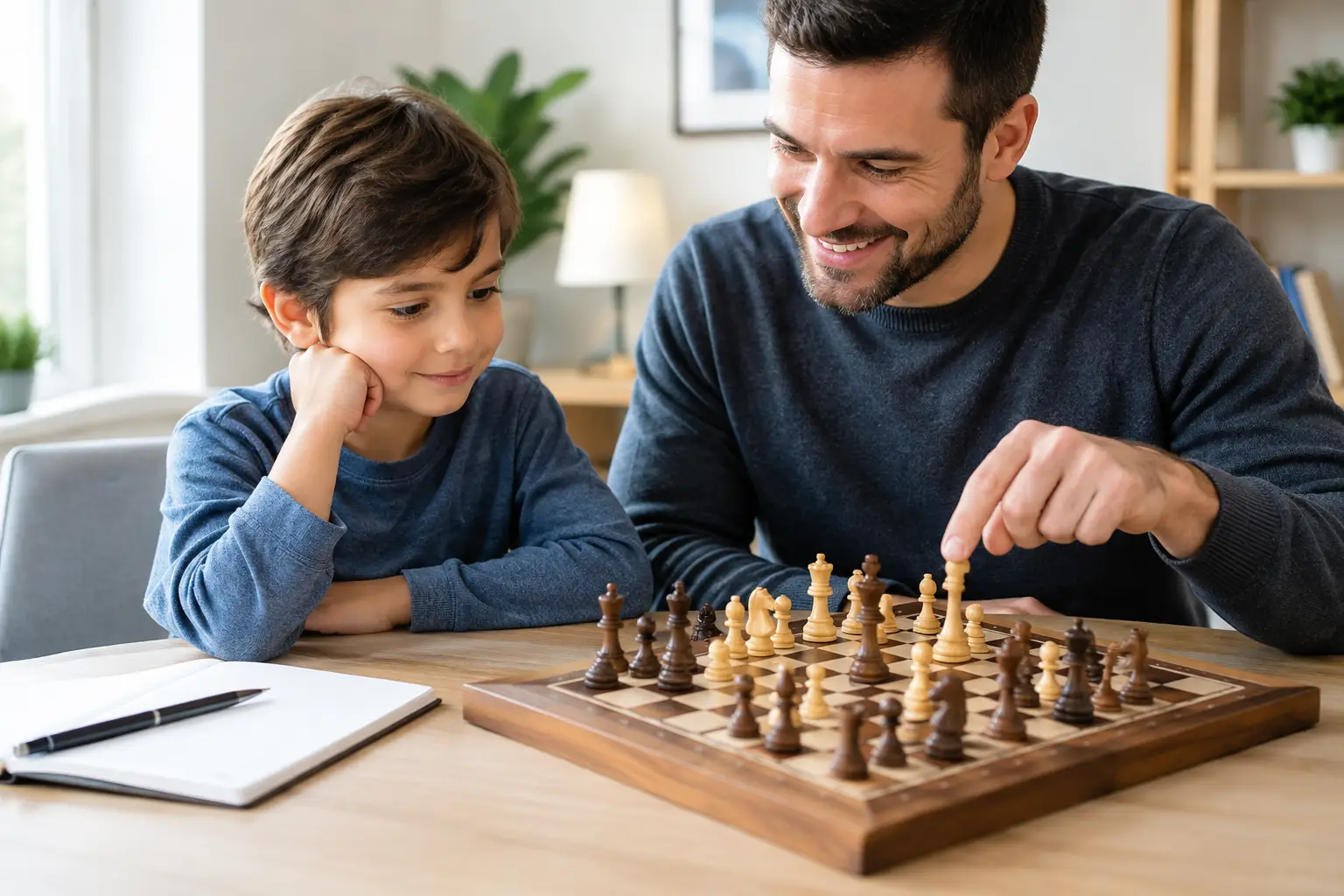
A child finishes a game, proudly announces checkmate, then looks down at a tournament scoresheet full of letters and numbers. For a beginner, chess notation can look like a secret code. It is actually a simple record of what happened on the board. This guide to chess notation basics gives parents a clear way to help kids understand that code without turning a fun game into homework.
Chess notation is not usually the first skill a child needs. Young beginners should first learn how the pieces move, how to spot check, and how to play a complete game. But once those foundations are taking shape, notation becomes useful quickly. It helps children review mistakes, follow lessons, read chess books, and feel more prepared for tournament play.
What chess notation means
The system most players use is called algebraic notation. Every square has a name, and every move is written with a few letters, numbers, and symbols. Rather than drawing the whole board after each move, a player can write a move such as e4 or Nf3.
Think of the board as a map. The letters identify the vertical columns, called files, and the numbers identify the horizontal rows, called ranks. Files run from a through h. Ranks run from 1 through 8.
From White's side of the board, the square in the lower-left corner is a1. The lower-right corner is h1. The upper-left corner is a8, and the upper-right corner is h8. This viewpoint matters. Chessboard coordinates do not turn around when Black moves.
A helpful first activity is to ask your child to find squares without moving any pieces: “Where is e4?” “Can you point to g7?” Keep it light and quick. Five minutes of board-coordinate practice is far more effective than asking a beginner to memorize the entire grid at once.
The letters used in chess notation
Most pieces are represented by a capital letter. The king is K, queen is Q, rook is R, bishop is B, and knight is N. Knights use N because K is already reserved for the king.
Pawns are the exception. They do not use a letter. A pawn move is written only with the square where it lands. If a White pawn moves from e2 to e4, the notation is simply e4.
Here are a few common examples in plain language:
- Nf3 means a knight moves to f3.
- Bc4 means a bishop moves to c4.
- Qd1 means a queen moves to d1.
- e4 means a pawn moves to e4.
At first, children may ask, “But which knight?” That is a smart question, and it leads to one of the more advanced parts of notation. For now, the main goal is learning to identify the piece and its destination square.
A small detail that prevents big confusion
Notation tells us where a piece ends up, not always where it started. For example, Nf3 does not state that the knight began on g1. Usually, the legal moves on the board make the starting square obvious.
Encourage your child to say the move aloud before writing it: “Knight to f3.” Then they can translate it into Nf3. Speaking first helps many young players connect the board action with the written symbol.
How captures are written
When a piece captures another piece, chess notation uses an x. The x means “takes.”
If a bishop captures a piece on f7, write Bxf7. If a queen captures on d5, write Qxd5. The piece letter comes first, followed by x, then the destination square.
Pawns need one extra detail. Because pawns have no letter of their own, notation uses the file the pawn came from. If the pawn on e4 captures a piece on d5, the move is written exd5. Read it as “the e-pawn captures on d5.”
This is often the point where children rush and accidentally write the wrong starting file. Slow the process down: ask, “Which file did your pawn come from?” Once they can answer that, pawn captures become much easier.
Special moves every beginner should recognize
A complete guide to chess notation basics should include the special moves children are most likely to see in lessons and games.
Check and checkmate
A plus sign means check. If a rook moves to e8 and attacks the king, write Re8+. The plus sign is added after the move.
A number sign, #, means checkmate. If the queen moves to h7 and delivers checkmate, the notation is Qh7#. Some books use two plus signs for checkmate, but the number sign is common and easy for kids to recognize.
Teach the meaning before emphasizing the symbol. A child should understand that check means the king is under attack and must respond. Checkmate means there is no legal response.
Castling
Kingside castling is written O-O. Queenside castling is written O-O-O. These are capital letter O's, not zeros.
This can feel odd because the king moves two squares and the rook moves too, yet no piece letter or destination square appears. It is simply a special shorthand. Most children remember it once they have castled in a few real games.
Pawn promotion
When a pawn reaches the last rank, it promotes, usually to a queen. If a pawn moves to e8 and becomes a queen, write e8=Q. If that promotion gives check, write e8=Q+.
Promotion is less common in early beginner games, but kids enjoy learning it because it feels dramatic. It also reinforces an important idea: the notation records the full result of a move, not just where a piece lands.
En passant
En passant is written like a regular pawn capture, such as exd6. Some players add “e.p.” afterward, but it is not required in standard algebraic notation. For young players, the priority is learning the rule correctly first. The notation can wait until they have seen the move on the board.
When two identical pieces can move to the same square
Sometimes both knights, rooks, or bishops could legally move to the same destination. Chess notation must show which one moved.
Suppose one knight is on d2 and another is on h2, and either knight can move to f3. If the knight from d2 moves, write Ndf3. The added d tells us that the knight came from the d-file.
In other positions, the rank is needed instead. If rooks on a1 and a5 can both move to a3, the move from a1 may be written R1a3. This is called disambiguation. It sounds technical, but parents do not need to drill it early. Children usually absorb it naturally after they are comfortable with ordinary moves.
A practical way for kids to learn notation
Notation works best when it follows real chess, not when it is taught as a disconnected worksheet. After a short game, choose just five moves to record together. Start with obvious moves: pawn advances, knight moves, and a capture.
Then replay those moves on the board. Ask your child to read the notation out loud and make the move. If they wrote Bxc6, can they find the bishop, identify what was captured, and place the bishop on c6? This turns notation into an active puzzle instead of a spelling test.
For a child who is easily frustrated, keep the goal modest. Recording the first ten moves accurately is a win. For a tournament-bound player, build the habit of pausing after every move, checking the board, and writing clearly before touching the clock again. Speed comes later. Accurate scoresheets matter more.
At Savushkin Chess, coaches use notation as a tool for understanding games, not as a barrier to enjoying them. A child who can review one missed tactic from their own recorded game begins to see why careful thinking matters.
What parents should watch for
The most common notation mistakes are completely normal: mixing up b and d, writing a pawn capture without its starting file, forgetting the x on a capture, or using K for a knight. Correct one pattern at a time rather than marking every error.
It also depends on your child’s age and experience. A four- or five-year-old may benefit most from learning square names through a game. An older beginner who wants to play rated tournaments may need more direct scoresheet practice. In both cases, praise the process: careful observation, patience, and willingness to correct a move.
Chess notation gives children a way to preserve their ideas. When they can look back at a game and say, “Here is where I found the check,” the board becomes more than a momentary puzzle. It becomes a record of progress they can build on, one move at a time.

Ready to see chess click for your child?
Book a free 20–30 minute trial lesson with one of our coaches — no commitment, no payment needed.


