
How to Improve Board Vision in Young Chess Players
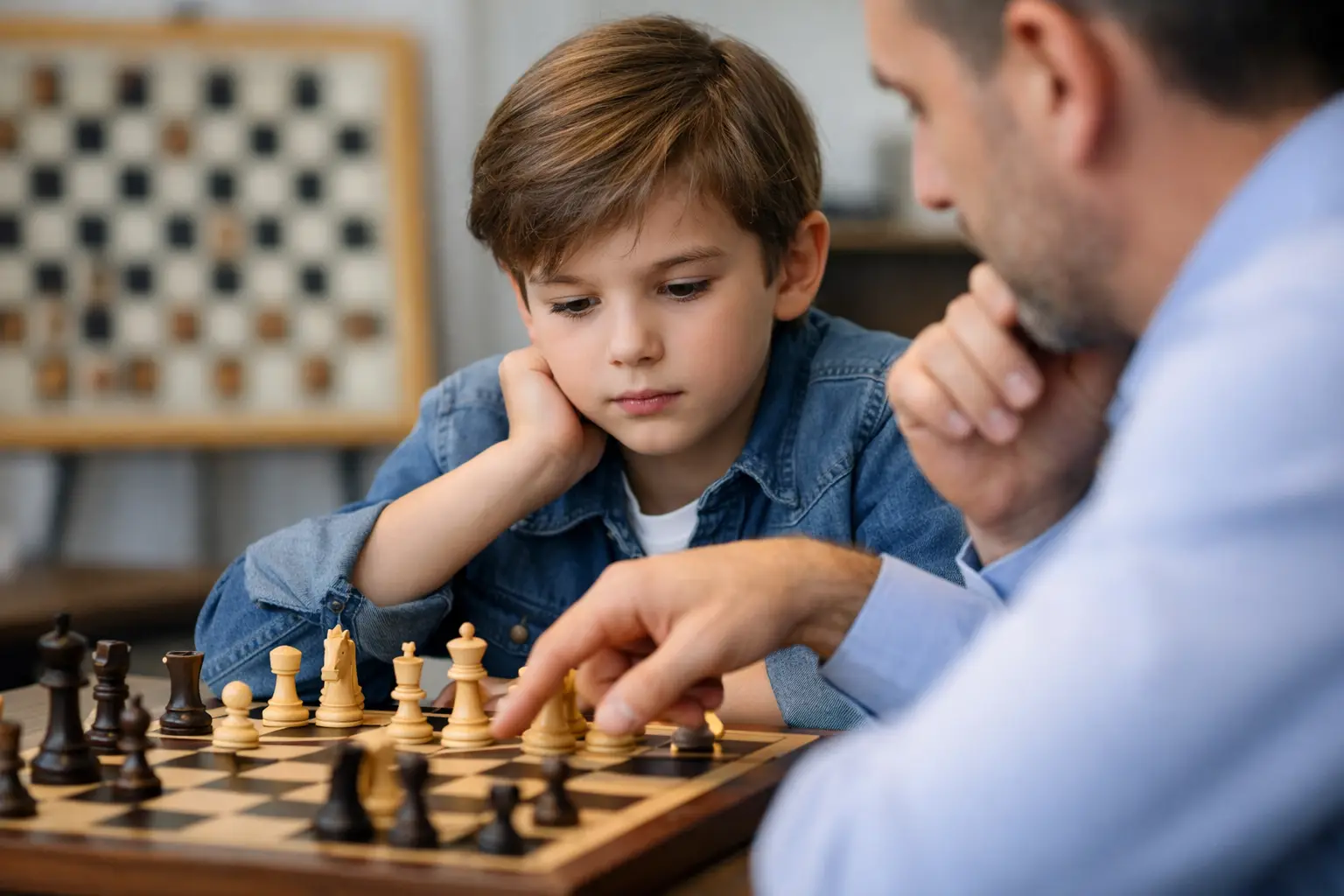
A child can know how every chess piece moves and still miss a queen hanging in plain sight. That is not a lack of intelligence or effort. It usually means they are still learning how to improve board vision: the ability to see the whole position, notice what has changed, and spot threats before making a move.
For young players, board vision develops through short, repeatable habits. It is one of the biggest differences between a child who plays moves quickly and a child who begins making confident, purposeful decisions. The good news for parents is that this skill is highly teachable, even for beginners.
What Board Vision Means in Chess
Board vision is not simply looking at the board for a longer time. It is the habit of taking in the important information before choosing a move. A player with stronger board vision can recognize attacked pieces, open lines, possible captures, weak squares, and tactical opportunities.
At the beginner level, this often starts with very practical questions: Is any piece attacked? Is my opponent threatening something? If I move this knight, what will it stop protecting? As a child gains experience, those questions become faster and more natural.
Many children focus only on the piece they want to move. That is completely normal. They see a knight jump or a pawn advance and want to make the exciting move right away. Strong board vision teaches them to pause, scan, and consider the other pieces that may be affected.
Why Young Players Miss What Is Right in Front of Them
Children usually miss tactics for a few predictable reasons. They may be eager to move, distracted by their own plan, unfamiliar with a pattern, or overwhelmed by a crowded board. A fast online game can make the problem worse because there is little time to reset and think.
Parents should avoid labeling these misses as careless. A child who overlooks a bishop attack may be working hard, but their eyes and brain have not yet learned where to look first. Correction works best when it is calm and specific: “Before you move, let’s check what your opponent is attacking.”
This approach builds confidence. Instead of feeling bad about a mistake, your child learns that every position has a routine for finding the answer.
How to Improve Board Vision With a Simple Scan
The most useful habit is a consistent pre-move scan. It does not need to take a full minute. For a young beginner, even five to ten focused seconds can prevent many lost pieces.
Teach your child to look at the board in the same order before every serious move:
- What did my opponent’s last move change?
- Is my king in danger, or is any of my piece attacked?
- Do I have a safe capture, check, or threat?
- After I move, can my opponent take that piece or win something else?
At first, prompt these questions aloud. Later, ask your child to whisper them or think through them silently. The goal is not to turn chess into a checklist forever. The goal is to build a reliable thinking pattern until it becomes automatic.
For very young players, simplify the language. Ask, “What is their piece looking at?” or “Is anything of ours unsafe?” Clear questions are more helpful than broad instructions such as “Think harder.”
Start With the Opponent’s Last Move
This is the most overlooked step in children’s chess. After an opponent moves, many young players immediately search for their own favorite move. Encourage them to first ask, “Why did they move there?”
A pawn may have opened a bishop’s diagonal. A knight may now attack two pieces. A queen may be aiming at an unprotected pawn. Looking for the purpose of the last move helps children stop reacting late and start seeing the game as a conversation between two plans.
Use Short Board Vision Drills, Not Long Lectures
A ten-minute drill done several times a week is more effective than one long session that leaves a child frustrated. Keep the challenge level manageable. If every puzzle feels impossible, the child is not training vision - they are guessing.
Find the Attacked Piece
Set up a position from a recent game, or use a simple position with only a few pieces. Ask your child to name every white piece under attack, then every black piece under attack. Do not ask for the best move yet.
This drill trains the eyes to travel across the whole board. It also reinforces a key lesson: pieces are not safe just because they are far from the action.
One-Move Tactics
Use positions where the answer is a single move: a checkmate in one, a free piece, a fork, a pin, or a simple defended capture. Ask your child to identify all checks first, then captures, then threats.
This order matters. Checks are forcing and often easiest to calculate. Captures reveal loose pieces. Threats help children look beyond the immediate exchange. As their skill grows, ask them to explain why the move works before they play it.
Cover and Uncover
Place a small object over one square in a position and ask your child what piece was there, what that piece protected, and what changes if it disappears. You can also remove a pawn from a familiar opening position and ask which lines become open.
This is a fun way to teach that every piece has a job. It develops awareness of defenders, diagonals, files, and ranks without feeling like a formal test.
Replay Their Own Games
A child remembers their own surprise much more clearly than a random puzzle. After a game, choose one or two moments where they lost material or missed an opportunity. Recreate the position and ask, “What could we have checked before moving?”
Keep the review brief and encouraging. Do not replay an entire game just to point out every error. One clear lesson such as “your bishop was protecting the knight” is more likely to carry into the next game.
Build Pattern Recognition Before Asking for Deep Calculation
Board vision is partly calculation, but it is also pattern recognition. Experienced players do not examine every square from scratch. They recognize familiar ideas quickly: a knight fork on c7, a pin along an open file, a back-rank weakness, or a bishop aimed at an undefended piece.
Children build these patterns by seeing them many times in different positions. That is why simple puzzles can be so valuable. A child who solves several easy knight-fork puzzles starts noticing the same shape during real games.
There is a trade-off here. Hard puzzles can be motivating for a child who enjoys a challenge, but they should not replace easier repetition. If your child is just beginning, success with basic pins, forks, and hanging pieces creates the foundation for more advanced tactics later.
Slow Down Without Making Chess Feel Slow
Some children play fast because they are excited. Others rush because they are nervous about making the wrong move. A practical solution is to create a “hands off” rule: once they see a move, they must take one last look before touching the piece or clicking the square.
For online games, encourage a time control that gives room to think. Bullet and very fast blitz games can be entertaining, but they reward speed more than careful observation. Longer games, even 10-minute games, give young players a chance to practice their scan.
That does not mean every game needs to be slow. Fast games can help children enjoy chess and practice familiar patterns. Just balance them with enough thoughtful play that board vision has time to grow.
Help Your Child Track the Whole Board
A common beginner habit is staring only at the center or only at the side where a battle is happening. Teach your child to deliberately look from left to right and then up and down. This can feel mechanical at first, but it catches rooks on open files, bishops on long diagonals, and forgotten pawns near the edge.
It also helps to use correct board orientation. White should have a light square on the bottom right. When children regularly see the board set up correctly, they become more comfortable identifying squares and visualizing piece movement.
As their confidence grows, ask them to name what each side wants. Maybe White is trying to attack the king while Black is trying to win a pawn. Seeing both plans strengthens board vision because it gives meaning to the pieces, not just locations.
When Extra Coaching Helps
If your child repeatedly misses one-move threats despite knowing the rules, personalized feedback can make a real difference. A coach can identify whether the issue is rushing, weak tactical patterns, confusion about piece movement, or difficulty organizing a thought process.
At Savushkin Chess, coaches work with children step by step, using positions that fit their current level rather than pushing the same lesson on every player. For a beginner, that may mean learning to spot attacked pieces. For a tournament-minded player, it may mean calculating a tactical sequence without losing track of the full board.
The most encouraging sign is not that your child suddenly sees every move. It is when they begin to pause on their own, look at the opponent’s idea, and say, “Wait, that piece is hanging.” Those small moments are how strong chess thinking starts.

Ready to see chess click for your child?
Book a free 20–30 minute trial lesson with one of our coaches — no commitment, no payment needed.


