
How to Improve Calculation Skills in Chess
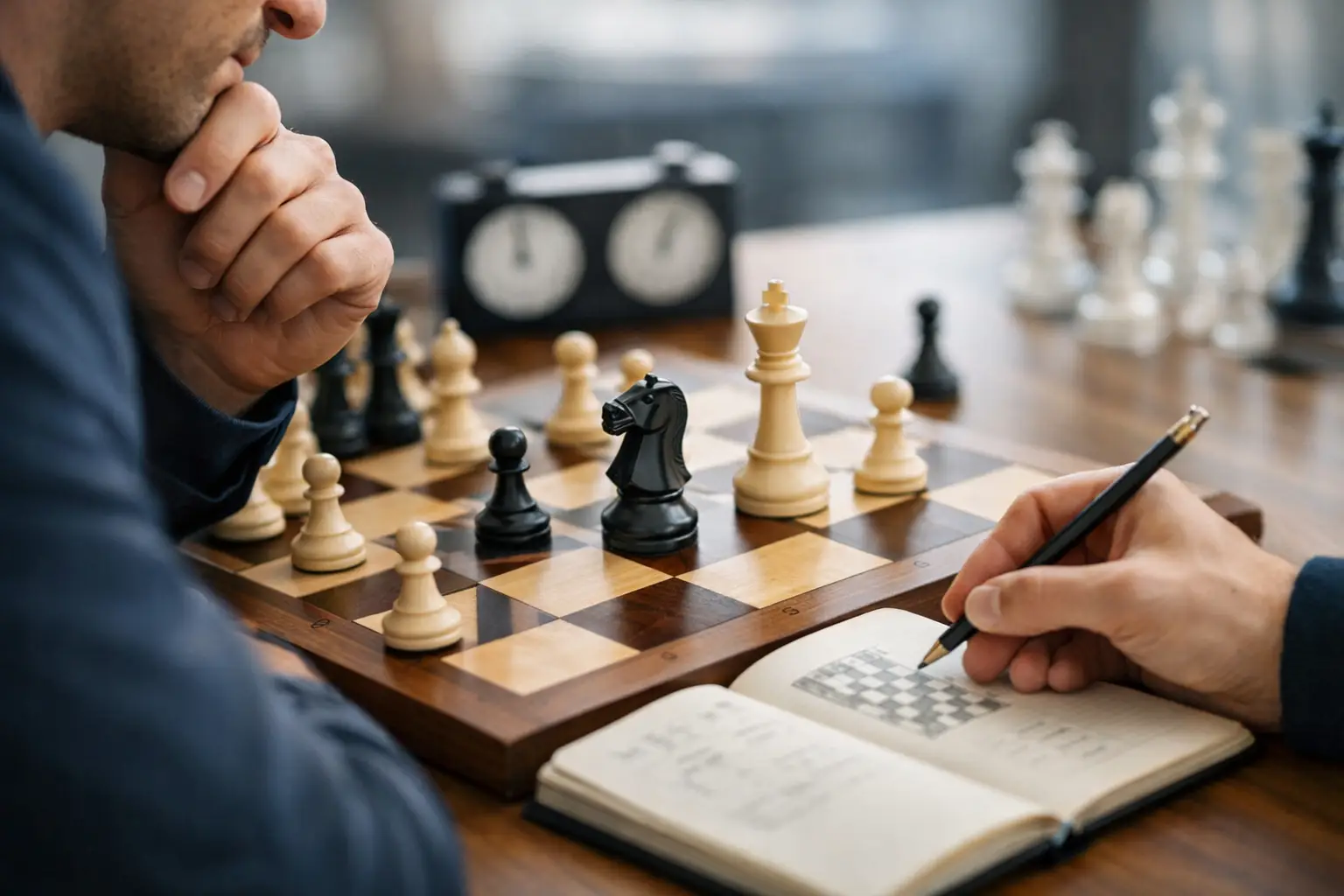
A child can know how every chess piece moves and still freeze when it is time to choose a move. The missing skill is often calculation: the ability to look ahead, test an idea, and notice what the opponent can do next. Learning how to improve calculation skills is not about making kids stare at the board longer. It is about giving their thinking a clear, repeatable path.
For parents, this matters beyond chess. Calculation teaches children to slow down before reacting, hold information in mind, and make decisions based on evidence instead of guesses. Those are valuable habits at the chessboard, in schoolwork, and in everyday problem-solving.
What calculation means in chess
Chess calculation is the process of mentally playing through possible moves before touching a piece. A young player might ask: “If I move my knight there, what can my opponent capture? If they capture it, what is my best response?”
Strong calculation is not the same as memorizing long move sequences. In most beginner and intermediate games, a child does not need to see ten moves ahead. They need to reliably see one or two moves ahead, recognize immediate threats, and check whether a move leaves a piece unprotected.
That distinction is reassuring. The goal is not to turn every game into a difficult mental test. The goal is to build a habit of thinking before moving, then gradually increase the difficulty as the child becomes more confident.
Start with a simple thinking routine
Children calculate better when they have a small routine to follow. Without one, many players jump to the first move that looks exciting, especially a check or an attack. A routine gives them a pause button.
Before each important move, encourage your child to ask three questions: What is my opponent threatening? What are my forcing moves? What happens after my move?
Forcing moves are checks, captures, and threats. They are useful because they narrow the opponent’s choices and make the position easier to analyze. But a forcing move is not automatically a good move. A child may see a check and miss that their queen can be captured on the next turn.
A helpful phrase is: “Look at checks, captures, and threats - then check the safety of your pieces.” With repetition, this becomes a natural part of tournament play rather than a speech they have to remember word for word.
Teach the opponent’s turn first
One of the biggest calculation breakthroughs comes when children stop looking only at their own ideas. After choosing a candidate move, they should switch sides mentally and ask, “What would I play if I were my opponent?”
This is where many avoidable mistakes disappear. A child who wants to win a pawn may notice that the pawn is protected. A child planning a check may see that the opponent can simply capture the checking piece. The answer is not to discourage attacking chess. It is to help them attack with awareness.
At home, avoid supplying the answer too quickly. Try asking, “After your move, what is their strongest reply?” That one question keeps ownership of the solution with the child.
Build calculation skills with short, focused puzzles
Puzzles are one of the best ways to improve chess calculation skills because they remove the noise of a full game. The position has a purpose, and the child can practice spotting patterns without worrying about the entire board.
The quality of practice matters more than the number of puzzles completed. Racing through 30 easy puzzles may feel productive, but it can create a guessing habit. Solving five puzzles slowly, explaining the idea out loud, and checking every response often builds more lasting skill.
Choose puzzles that match your child’s current level. Beginners benefit from one-move and two-move tactics involving hanging pieces, forks, pins, simple checkmates, and basic defenses. More experienced players can work on combinations that require them to calculate several forcing replies.
When a puzzle is missed, do not treat it as a failure. Ask what they saw first, what they did not consider, and which opponent response surprised them. This turns a wrong answer into a useful lesson in attention.
Use the “say it before you move it” rule
Whether your child is solving a puzzle or playing a game, have them say their line aloud before moving pieces on the board. For example: “I take the knight. They take my queen. Then I take their queen.”
Speaking the line slows impulsive moves and reveals gaps in the calculation. If a child cannot explain what happens next, they may not be ready to make the move. Younger children may only manage one reply at first, and that is completely appropriate. Progress should feel challenging but achievable.
For visual learners, it can help to point to each square without moving the pieces. This protects the position while they think and makes the mental process more concrete.
Practice from real games, not puzzles alone
Puzzles develop tactical vision, but real games teach children when to use it. After a game, choose one or two turning points rather than analyzing every move. Ask where they felt uncertain, rushed, or surprised.
Then return to that position and give them another chance. “What moves would you consider here? Which one is safest? What is Black’s best response?” Children often find a stronger move when there is no clock running and no pressure to win immediately.
This kind of review also helps parents see the real issue. Sometimes a child is not struggling with calculation at all. They may be missing a basic rule, such as defending pieces, or they may be unfamiliar with a common tactical pattern. In those cases, more complicated calculation exercises will not fix the problem. The player needs the missing foundation first.
A coach can be especially helpful here because personalized feedback separates a one-time oversight from a repeating habit. At Savushkin Chess, lessons can use a child’s own games to connect tactical practice with the decisions they make in live play.
Make board vision part of the routine
Calculation depends on accurate board vision. If a child forgets that a bishop attacks along a diagonal or overlooks a knight jump, even a sensible plan can fall apart.
A quick scan before moving can prevent many errors. Encourage your child to notice loose pieces, attacked pieces, open lines, and squares controlled by knights. This does not need to become a long checklist every turn. At first, use it on tactical moments: before a capture, before a check, or when an opponent has just moved a piece near the king.
It also helps to play slower games sometimes. Fast chess is fun and can build quick pattern recognition, but it does not give beginners enough time to practice careful calculation. A good balance depends on age and experience. A six-year-old may stay focused for only a short game, while an older tournament player benefits from longer time controls and structured post-game review.
Help children manage emotions at the board
Calculation breaks down when a child feels rushed, frustrated, or overly excited about an attack. Parents can support progress by praising the process, not only the result.
Instead of saying, “Why didn’t you see that?” try, “I like that you stopped and checked their response.” Even when the move was not best, that is the habit that will lead to improvement. Confidence grows when children learn that mistakes are information, not proof that they are bad at chess.
A practical reset is to have them sit on their hands for three seconds before an important move. It sounds simple, but it creates enough space to scan the board and remember the thinking routine. For younger players, a quiet reminder such as “Pause, then check” works better than a long explanation in the middle of a game.
Set a realistic weekly practice plan
Consistency beats occasional marathon sessions. For many children, three short sessions each week work well: one puzzle session, one slow game, and one review of a recent game or lesson position. Keep the sessions short enough that they finish with energy still in the tank.
As skills improve, increase the challenge gradually. Start by asking for one move and the opponent’s reply. Later, ask for a full three-move line. The best sign of progress is not necessarily faster answers. It is fewer impulsive blunders, clearer explanations, and a child who begins asking, “What can my opponent do?” on their own.
The next time your child pauses over a move, let that pause be a win. It means they are learning to see chess as a conversation between two players, not a race to move first.

Ready to see chess click for your child?
Book a free 20–30 minute trial lesson with one of our coaches — no commitment, no payment needed.


